

Focus, focus, focus…
“Nothing forces you to learn faster than ignorance combined with the desire for success.”
— Ed Catmull
In 1986, after seven years of running his studio, Ed Catmull faced the challenge of developing Pixar. He became the president of Pixar Animation Studios, and his key product was the Pixar Image Computer—a device designed for processing computer graphics for films and animation. The business model revolved around offering new hardware solutions, which was a new challenge for Catmull, as Pixar had primarily been focused on animation production until then. His biggest problem? He had no idea how to navigate his new role. To tackle this challenge and acquire the necessary skills, he did what any reasonable person would do in such a situation—he turned to management and business books. Most of them offered simple solutions that created an illusion of confidence. These books were filled with catchy phrases that promised a fast track to success, such as: “Don’t be afraid of failure”, “Lead by following others, and they will follow you” or “Focus, focus, focus…”
The last piece of advice is particularly interesting because, just as in 1986, it still sounds both highly convincing and enigmatic at the same time. It’s a statement that’s hard to disagree with, yet it doesn’t really change much in practice. You hear it often, people nod as if it’s an undeniable truth, and then they repeat it without further reflection. In his book Creativity, Inc., Ed Catmull describes how such advice frustrated him. While these slogans sound wise, they don’t provide any concrete guidance on what actually needs to be done. If you don’t know what to focus on, this kind of advice won’t be of much help. The issue of focus is deeper. Instead of nodding in agreement, we should be asking firm questions: “What exactly should we focus on?” and “How can we determine that effectively?”
Why is focus so important?
“You definitely want to achieve more, but—ironically!—this requires efficient elimination of tasks rather than multiplying them. Less is more. You need to handle as few things as possible that will yield the greatest impact.”
— Gary Keller
If you truly know what you want to achieve and have a clear vision of your desired outcomes, formulating an action plan and narrowing it down to key aspects becomes somewhat easier. I say somewhat because while it simplifies the process, it doesn’t make it easy. How to effectively turn goals into projects, break them down into milestones, and then into specific, chronological tasks is a topic for another article on goal management and OKRs. Today, however, let’s focus on a scenario where you’re still unsure where to start. You feel the need for change, you have a vague vision of what things should look like afterward, but you don’t know which areas, processes, or problems should be addressed first. In this situation, specific tools can help crystallize key aspects. Dear leader, regardless of your exact role within the organization and your level of influence or autonomy in managing change, today’s article introduces an incredibly effective tool to help you gain clarity on focus areas. It is structurally neutral, meaning it can be applied regardless of your position in the organization, whether you are a managing director, department head, or team manager. No matter your level in structure, you can still effectively identify the key areas worth focusing on.
SWOT Matrix – A tool to define focus
#SWOT is one of the simplest yet highly effective strategic tools. It can be applied at an organizational, team, or even individual level. It consists of four elements: strengths, weaknesses, opportunities, and threats. This framework allows for a quick understanding of internal and external factors, enabling the identification and selection of focus areas for the upcoming period. The matrix is divided into two sections: the left side covers positive factors, while the right side deals with negative aspects. Additionally, the upper part of the framework focuses on internal factors, over which we have direct control, while the lower section relates to external factors that influence us but are not fully within our control.
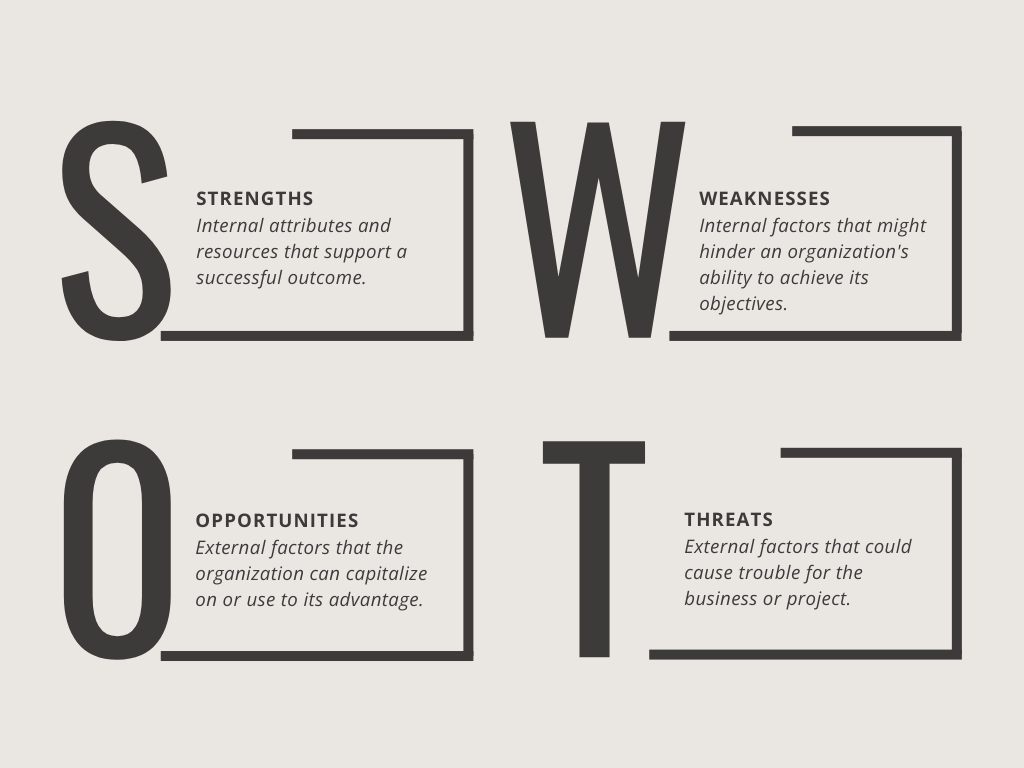
Effectively utilizing SWOT analysis involves two stages. The first is a fact-based brainstorming session with key stakeholders, emphasizing openness, objectivity, and avoiding distortion of reality. The goal is to determine the actual state of affairs as a foundation for further actions. The second stage is the implementation of those actions. The identified elements must be further analyzed to determine how to leverage strengths, minimize weaknesses, capitalize on opportunities, and manage threats.
Strengths:
Which of our strengths should we leverage to gain a competitive advantage or navigate an upcoming challenging period? Which of these elements are critical and should serve as the foundation of our growth strategy? In other words—what are we good at? Let’s use that to our advantage!
Weaknesses:
Which of our weaknesses have a significant enough negative impact on our business that they must be addressed? Of course, one might think that all weaknesses should be eliminated to improve efficiency and organizational effectiveness. However, this brings us back to the core principle—FOCUS. Not everything that can be done should be done, and certainly not all at once.
Opportunities:
What opportunities exist in the changing market, regulatory environment, economic landscape, or competitor actions that we can leverage to our advantage? For instance, imagine it’s the last quarter of the year, and new regulations will take effect at the start of the next year, significantly impacting your business. Instead of complaining—which won’t change anything—you can shift your perspective and see the opportunity in the challenge. After all, these regulations apply to the entire industry, not just you. Your competitors will also feel their impact. The key ability that will give you an edge is agility in adaptation—that’s what differentiates modern businesses. In short, whoever adapts fastest wins the race, leaving competitors struggling behind.
“Danger and opportunity, after all, usually walk side by side. Being proactive and constantly evaluating new information means that you will be able to distinguish one from the other.”
— Jim Rohn
Threats:
The final element of our analysis is threats. Here, a more in-depth approach is required using a different tool: Risk Assessment. This involves identifying all potential threats and evaluating them based on two factors: the probability of occurrence and the impact they would have on the organization if they did occur. Based on this assessment, threats can be classified into four categories, each requiring a different approach:
High probability & high impact: These threats should be addressed immediately with priority. A dedicated project should be created to mitigate them.
High probability & low impact: These threats should be monitored, and standardized procedures should be established to efficiently handle potential issues.
Low probability & high impact: While these threats are unlikely, their potential impact is significant. A contingency plan should be prepared to ensure a data-driven response rather than an emotional reaction when the problem arises.
Low probability & low impact: Simply put, don’t waste time on them. Instead, focus efforts on more critical areas.
SWOT: Summary
The key to effective action is not just execution but ensuring the right actions are taken in the first place. Don’t focus on running the fastest until you’re sure you’re running in the right direction. Sometimes, taking small steps in the right direction with the wind at your back is far better than expending all your energy trying to sprint the other way.
Thank you for reading this article.
If you’d like to explore the potential of a SWOT analysis in practice, you can download the attached layout by clicking the Download button.
For more insights on effective management, explore other articles in our Free Learning Hub. Have questions or want to develop your team’s skills? Contact us via the Contact Form or reach out to me directly on Linkedin.
All quotes used in this article are from the following books:
Creativity Inc. – Overcoming the Unseen Forces that Stand in the Way of True Inspiration by Ed Catmull
The One Thing – The Surprisingly Simple Truth Behind Extraordinary Results by Gary Keller
My Philosophy for Successful Living by Jim Rohn